
how to design green buildings
How do we realistically turn our ambitious mission into practical and well designed spaces?
by MOSS
This article will give you an insight in the everyday business of our company. This is an introduction to our starters guide on how to make a sustainable, innovative and well designed green plan. Before we dive into the practicality of designing green buildings, we want to start with our five holy design mantras. All “MOSSies” know the importance of these mantras, which are the heart and soul of our work.
our principles at MOss
Living plants are heroes
- The power of nature is miraculous. Rule number one: the plant comes first. Our mission is to honor and advocate plants in our designs. Research proves it is psychologically and physiologically fundamental for us to experience nature on a regular basis. Even gazing at nature can help improve attention and performance.
No plant stands alone
- In nature, you never find plants singled-out. By grouping plants together in small ecosystems, plants can establish harmony and harness their own protection network to reduce the spreading of any threats. When we mirror the natural environment’s way of companion planting, we can create happier plants while also increasing the impact of greenery.
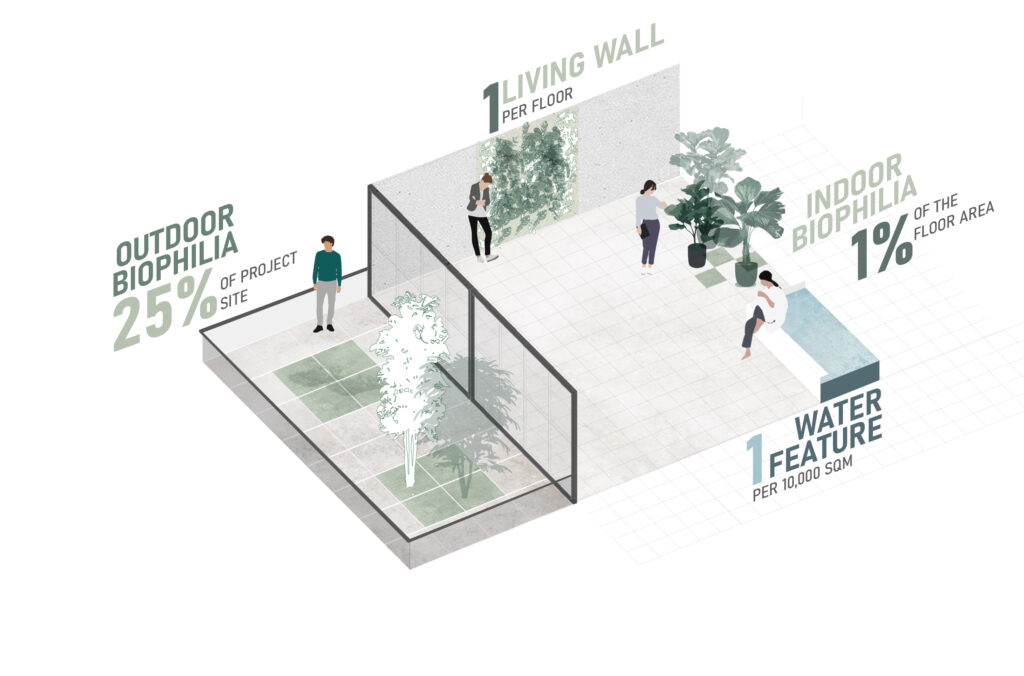
Do not add, but integrate green
- Depending on how you add green, you can create a feeling of comfort, scale, coziness, intimacy, or for example, collaboration. Some green elements help guide a circulation zone while others divide a room. We strive to explore and apply several solutions of green elements to support the program and function of the space.
Where’s the food?
- What if 1/4 of all ornamental plants were replaced with edible varieties? Imagine all of the healthy, hearty and nutritious calories we could grow for our community. In our designs we explore related themes, like urban agriculture, to answer more pressing questions of our future.
Honor biodiversity
- There are around 400,000 species of plants on Earth! To maximize the ecological function of urban spaces, we persist in supporting diversity through our designs. Yet heterogeneity has its boundaries, because the surroundings of the environment should be respected by bringing back and honoring indigineous species that belong to that area.
- In addition to taking these mantras as starting points in our designs, there are further important topics we have to address in order to successfully realize a green building.
These are the practical considerations which must be accounted for:
- A Plant’s Energy (Light, Soil, Water, Climate)
- Design Process (Space – width / height, Purpose, Ecosystem, Design integration)
- Construction (Weight, Wind, Costs)
- Maintenance
What does a plant need to stay alive? The plant’s energy comes mainly from water and light, but we should not underestimate soil as a major source of nutrients needed by plants for growth. Here we briefly highlight all of the elements that are needed for plants to grow, in order to start to learn the tricks of the trade.
1. Light
We all know sunlight is a key element for photosynthesis; the process that turns light energy into the energy that plants need to stay alive. To capture that precious resource, plant leaves adapt and specialize in sun or shade. Simply said, some plants (or leaves) favor light and some favor shade. For outdoor green projects, it is therefore important to acknowledge the preference of the plant and to place it accordingly in the planting lay-out in order to achieve a stable green design.
Doesn’t a plant need UV light? A plant does not necessarily need UV. UV can even damage plants if they are not acclimated. It would be best if a plant gets about two minutes of sunlight every 2 hours. The small exposure to UV in sunlight helps make plants stronger as they adapt to protecting themselves.
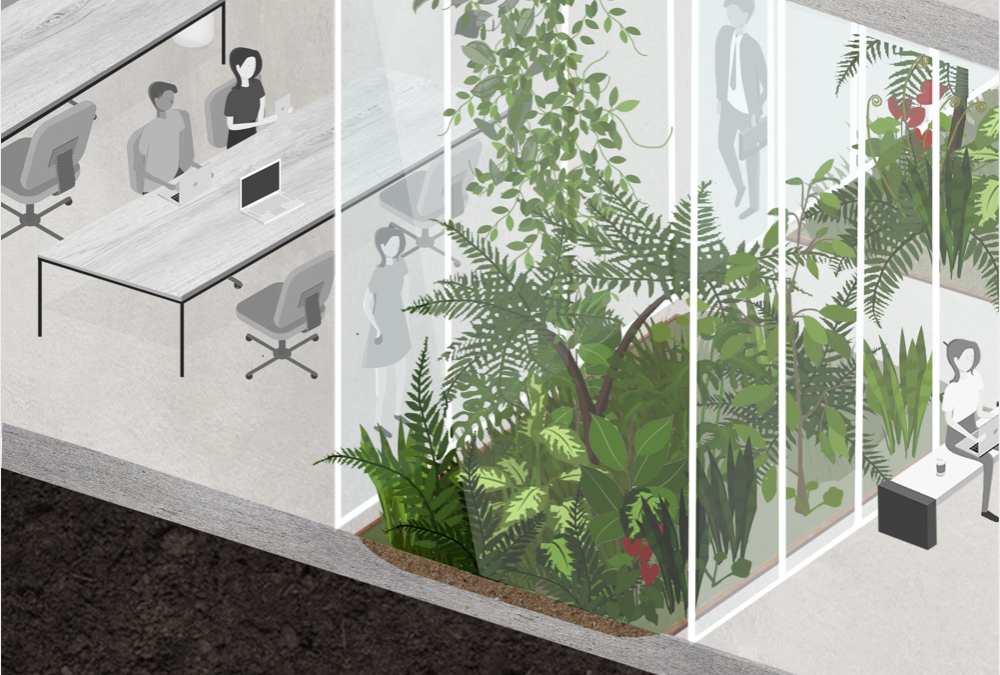
To make sure indoor plants can harvest enough light, we aim to place greenery around skylights, clerestories or windows, as shown in this graphic. If that is not an option, nowadays ‘grow’ lights are able to create electromagnetic radiation, also known as “full spectrum light”, which is the key ingredient in photosynthesis. Not all wavelengths of light are optimal for photosynthesis, actually plants photosynthesize electromagnetic radiation in the 400 to 700 (red – blue) nanometer range. Grow lights take over the role of the sun and make it possible for plants to grow in darker parts of the building. The advised amount of time to turn on grow lights is between 6-12 hours a day.
Adding grow lights is a task not many architects prefer. Thankfully nowadays there are a lot of design possibilities, including warm and white hue lights and a multitude of fixtures. Next to that, it is a matter of reserving the specifications early on to ensure a seamless integration of grow lights in the project.
2. soil
Soil is a vital part of our environment. Soil allows plants to grow, it holds and cleans water and it recycles nutrients while providing a home for a multitude of organisms on earth. Soil-based organisms are essential for enhancing nutrients which stimulate plant growth. Besides water and light, a plant is in need of three main nutrients : nitrogen (N), phosphorus (P) and potassium (K). Other important nutrients are calcium, magnesium and sulfur, all of which are found in healthy soil. If the soil is lacking minerals or nutrients, the soil cannot function correctly, leading to an array of problems.
So why are we supporters of using soil as our growing medium in green designs?
- Improved air quality. According to a study done by NASA in 1989, the plant root-soil zone appears to be the most effective area for removing volatile organic chemicals (VOCs). In their study they showed plants alone actually removed 8% of VOCs, whereas the roots and microbes removed 30%.
- Optimized plant growth. Tropical and indoor plants grown in hydro-culture are stagnant and passive, whereas plants grown in nutrient rich soil are 5 times more dynamic and ever-thriving!
- Broader range in plant diversity. Soil supports a broader range of plant diversity, hence soil culture plants are available with about four to five times more varieties than hydroculture plants. For larger plants there are about 10 times more species. As the roots develop a strong foundation in soil, plants can stand tall on a solid base.
- Less pests. Living soil systems are based on a revolving web of biological interactions known as the soil food web. All of soil’s ingredients impact both macro and micronutrients. When cared for with proper watering, light and climate, microbiota give the plant defense from pests or infection.
tips and tricks
- It’s best to use a potting mix for indoor plants. Use one that gives your plant roots the preferred air, moisture and nutrition balance.
- Hydroculture coils can be used at the bottom three cm of pots or planters for water storage, but fill the rest of the root zone with soil to optimize performance. Place a filter cloth in between the hydroculture and the soil, to make sure the layers stay intact. This system is called semi-hydro and is a great way to offer adequate water storage in combination with aeration.
- Additional feeding needs to be carried out after approximately 3 months of installation, and only in summer times when the plants are in their ‘growing period’. This is usually performed by the plant maintenance team.
What is the difference between soil and substrate? Commonly ‘soil’ just means ‘substrate’, or refers to ‘ground’. Basically the difference with ‘substrate’ is that it is a pre-fertilized material to be used and constructed in green designs. It is good to take into consideration that there is a distinct difference between indoor and outdoor substrate in matters of weight and substance. There is also a difference in quality (and eco-friendliness) between substrates being used, so take this into consideration while designing.
If we are using soil indoors, don’t we attract a lot of insects or other bugs? Whether using hydro or soil culture, plants are living organisms and can carry bugs. It is advised to have biological systems and proper maintenance in place to keep a healthy balance in the garden without spraying harmful chemicals found in pesticides.
3. Water
The subtle balancing act of watering is one of the most important tasks in plant care. Too much water can suffocate the plant roots, and too little water causes growth to become stunted. Water frequency should be steady and gradual, which is why we like to work with incorporating water storage layers into our planting designs.
But be careful, not all plants are similar in their water requirements. Some plants which thrive on intensive light need more water than plants which have lower light requirements. Throughout the installation and maintenance of the garden, it is essential to adjust the irrigation accordingly to the water usage. This can be done in collaboration with the professional plant maintenance team.
In general you can keep the following rules in mind:
- Larger plants need more water than smaller plants
- If the planter area is small, irrigation is needed more frequently
- Plants in sunny areas require more water than plants in low-lit areas
- Water meters and pop-up indicators are handy to simplify watering tasks
The quality of the irrigation water is also important for the health of your garden! The ideal temperature for irrigation water is between 16 and 22℃. This avoids shocking the plant with water that is either too hot or too cold. Next to watering the gardens manually, there are multiple ways of integrating low key irrigation systems in designs:
1. Drip irrigation: This is a micro-irrigation system that lets water drip slowly onto the roots of plants in pre-set time frames.
2. Capillary water storage: Additional water can be stored in a Water Retention Box and due to its capillair cones and cloth, the roots suck up water from below. Additional rainfall (for outdoor gardens) can be stored and used in periods of drought.
3. Pop up indicators: Adding indicators or control shafts is handy for checking the performance of your irrigation system.
Tip! Try to incorporate the use of rainwater in your outdoor or indoor gardens. Harvesting rainwater will make for a sustainable and future proof project.
4. Climate
Any outdoor green design, whether it’s for rooftop or ground level landscaping, must conform to the site’s climate. You can imagine a rooftop garden in Singapore is designed differently than one built in The Netherlands. Different species of plants, irrigation systems and maintenance requirements are in place to maintain a high quality landscape. To be able to see what works in a certain climate, it is advisable to start your design by doing field research with comparable projects in the same climate. What works, what does not work?
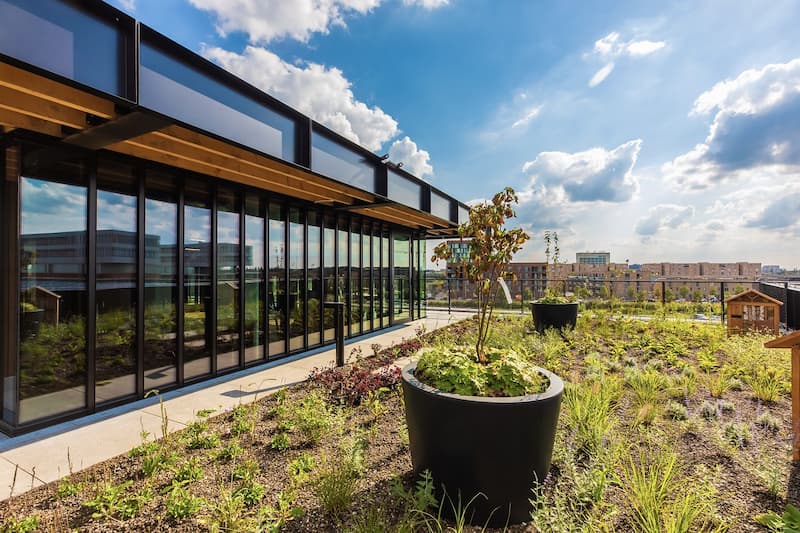
Before you start designing, also take into account the architectural surroundings; what is the position of the building in relation to other buildings? Are there shadows you should take into consideration? How does sunlight impact the site through different seasons?
For interior projects, temperature is the second most important factor influencing plant growth. While people feel comfortable in the range of 22 – 28℃, interior plants can tolerate and grow well within the 14 – 30℃ range. The ideal temperature range for indoor plants is 21 – 26℃ during the day and 18 – 21℃ at night.
Another important factor to consider is relative humidity, this is the amount of moisture contained in the air. For interior plants, relative humidity below 20% is considered low, 40% – 50% is medium, and above 50% is high. For example, in a greenhouse, relative humidity is 50% or higher.
The most frequently used indoor plant types come from the tropics, where high relative humidity is common. Therefore, take steps to help plants adjust to the new level of relative humidity in your building. The lower the humidity, the more water is lost from a leaf. At the same temperature of 21℃, a leaf placed in 10% relative humidity loses more water compared with the leaf placed in 50% relative humidity.
CONCLUSION
All of the above is a short introduction to the world of green architecture and the implementation of green in your projects. “A Plant’s Energy” is the first part of our starter’s guide towards a sustainable, innovative and well-designed green plan. In the next blog posts we will show more insights in our design process and the construction of green architecture.
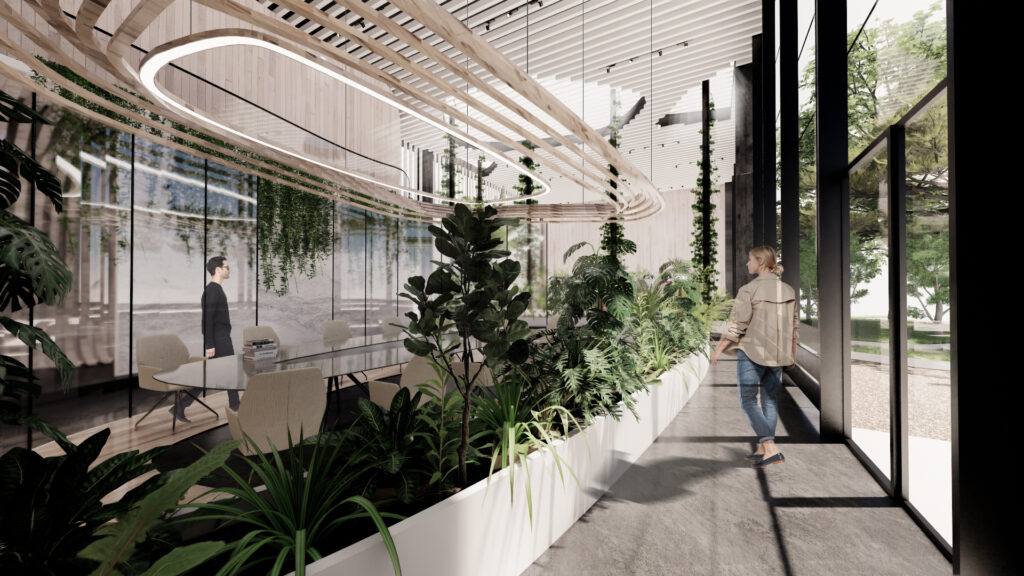
Incorporating plants in your design brings many benefits to people and to the environment. The earlier you include this planning in the process, the more innovation can incur! From an early project stage, we can plan for the best conditions for the plants and create solutions which are beautiful, future proof and eco-friendly. We believe in collaborations to find the perfect balance between the building, people, and our green environment.
Please contact us if you want to collaborate and let’s green up our built environment together!