
biophilia today
Biophilia influencing today’s architecture
by Isabella Baldi
Here at MOSS we often find ourselves looking for inspiration, not only in the present, but sometimes even in the past. It’s crucial for our design process to analyse case studies and find common features of our vision. Dr. Stephen R. Kellert, Professor of Social Ecology at the Yale University, was one of the first ecologists to study the concept of biophilia and to theorize the relative notion of Biophilic Design.
In a world like ours, highly dominated by artificial constructions, where climate change and species extinction are looming, it is increasingly rare to find hints of nature in everyday life. That’s why the concept of biophilia (sensitivity to a design approach more linked to biological nature), is taking on ever greater social and political urgency.
It may seem strange to think that this urgency to design involving nature actually dates back to a broader and more ancient architectural current: that of Organic Architecture and Biomimetic Design. The Organic movement refers to a design approach that aim to integrate itself with nature instead of going against it, celebrating the natural world.
Biomimetic Design, whose development is intertwined with Organic movement, seeks solutions for building sustainability present in nature, not only by replicating their natural forms, but also by understanding their mechanisms of survival. Biomimicry is by definition the act of learning from nature, borrowing designs and strategies that have worked in place for billions of years. The man who coined the term was Frank Lloyd Wright, renowned architect of the early 1900s. He treated a building as something alive, its development was influenced by the primary forces of nature: sun, wind, water and gravity.
“Buildings, too, are children of Earth and Sun.”
– Frank Lloyd Wright
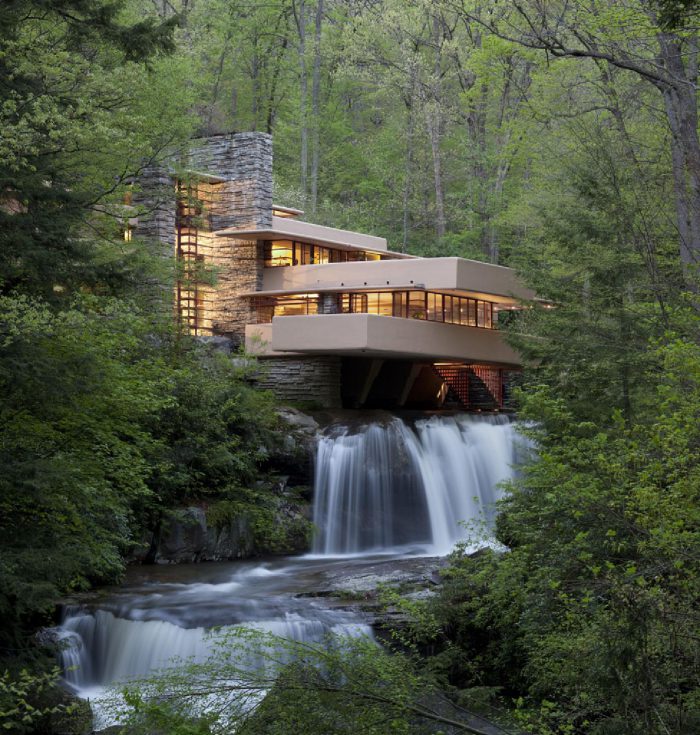
His most famous building is “Fallingwater”, which hovers over a waterfall in the Pennsylvania hills, wedging into the rock formation. It finds the perfect balance between nature and built space and represents the supreme victory over all the limits that had conditioned architecture for millennia, everything in this building is innovative.
CASA ORGANICA: CASE STUDY
Less well known is the brilliant and charming project by the Mexican architect Javier Senosiain, Casa Organica: initially conceived as a one-bedroom, peanut-shaped home set partially underground on a grassy hillside located in the north of Mexico City, in an industrial suburb called Naucalpan.
Extraordinary not only for his innovation, being built in 1984, but also because it was his very first project, it’s a great example of Biomimetic Architecture.
His aim was to create a house that would embrace nature in every aspect, detaching himself from preconceptions about what a proper house should be like. He decided to completely exclude the straight line in its designs, as:
“The straight line is pretty much absent from nature: everything from microorganisms to the macrocosm, from DNA strands to galaxies, shifts in spirals.
Before we’re born, we’re floating in our mother’s belly, like astronauts in space or a permanent Jacuzzi, but then we’re pushed into a box, a crib, and we move from one box to another throughout our lives — playpens, bedrooms, square houses — until we die and are put in another box. We make life for children very square, killing off liberty, spontaneity, and creativity. My designs want to go against this rule of life.”
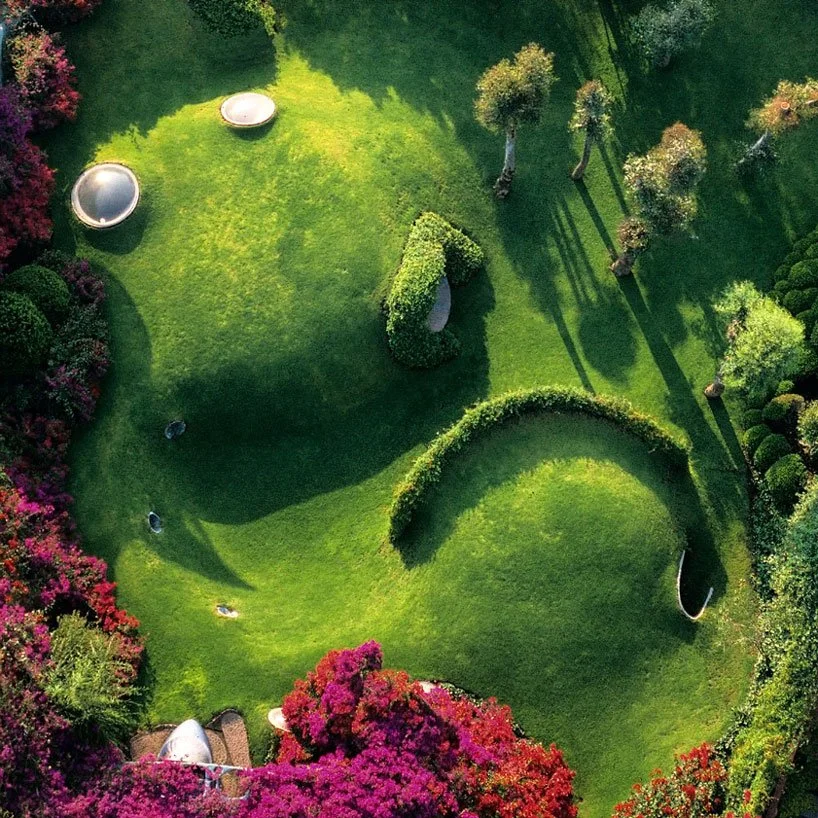
As his family grew bigger, he managed to change the project during construction, the result is a custom home divided in two spheres: one social, the other more private and intimate.
The construction process is totally fascinating: he used the ferrocement technique – traditionally a system of construction using moldable material (reinforced mortar or plaster) applied over an “armature” of metal mesh.
We have highlighted the biophilic features this brilliant house presents:
- Organic Plan: The shape of the house is inspired by a peanut shell. This particular shape evokes the same feeling of reassurance and protection of a cave, or even an animal shelter. The architect ‘s aim was to create spaces adaptable to the human body, “similar to the womb, an animal’s lair, the troglodytes who carved a niche for themselves out of the earth, and the igloo.”
In the Heart of Nature: The house is literally immersed into nature, melting with the hillside, it has a garden that it’s not only part of the residence, but it plays a crucial role about the climate stabilization. The roof garden in fact functions as a humidity and temperature regulator, that is kept within 18° and 23° C, making the use of a heater unnecessary. Also, Senosiain used trees and bushes to create green barriers to protect it from too intense sunlight and protect the house from dust and noise pollution.
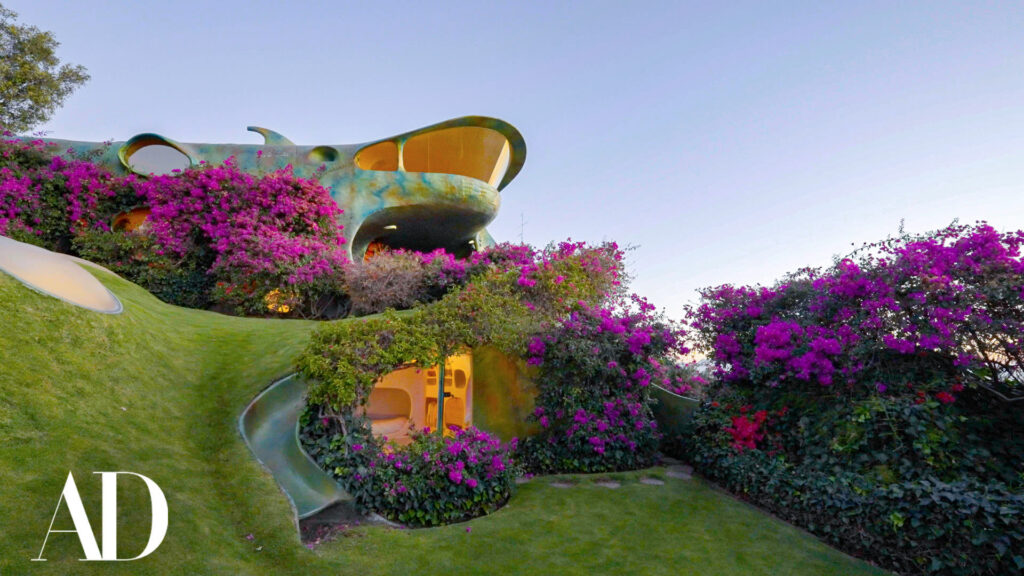
Like a flower: Have you ever heard of the word “phototropism”? This would be the capacity of a plant to orient itself towards a direction of light source, enhancing the ability of plants to optimize their photosynthetic capacity. This house, in a way, is sun oriented, just like a flower. Its windows were intentionally designed and incline to exploit optimal sunlight exposure.
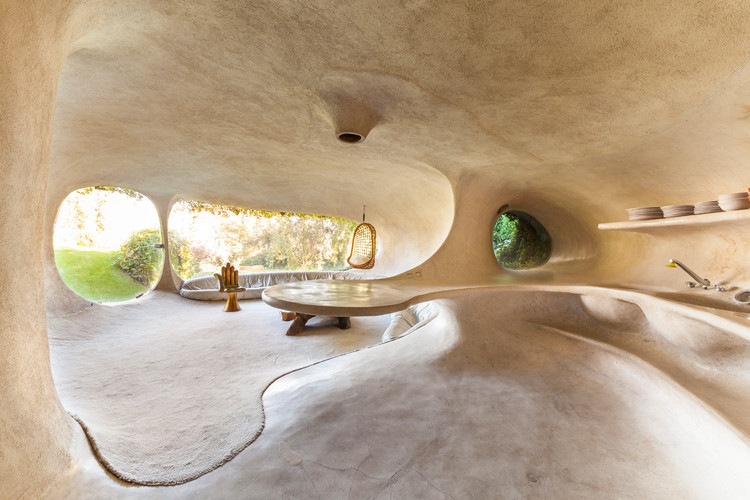
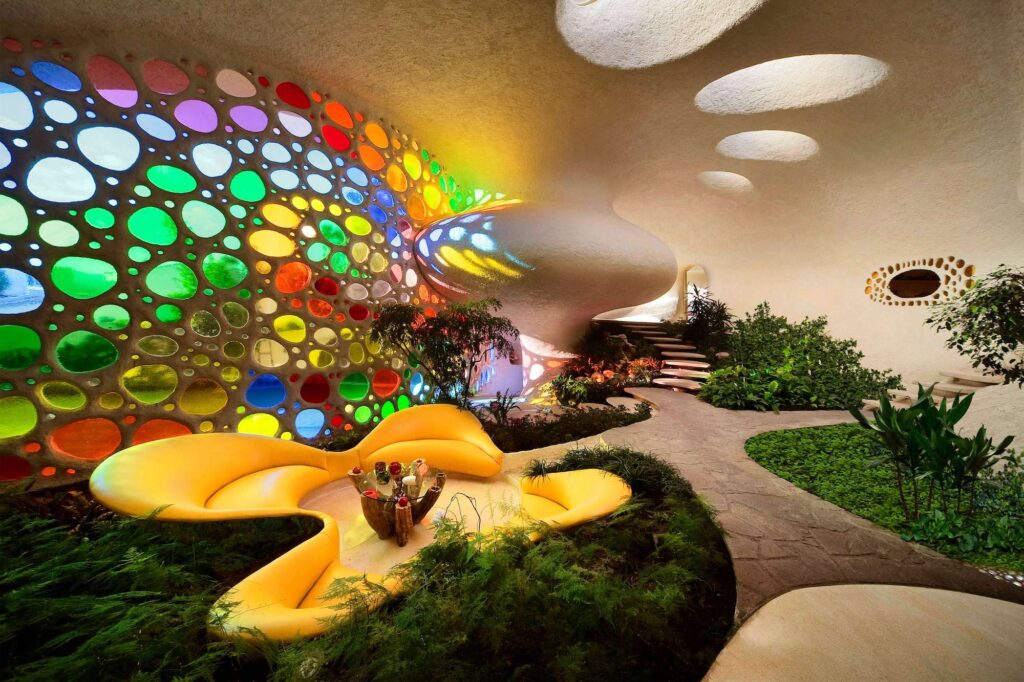
Visual connection to Earth: The indoor environment is furnished with elements recalling the shades of the natural world, inspired by the idea of visually connecting to space to the natural environment. For example, the floor is covered by a carpet that’s the same color as the walls, so the organic feeling is not interrupted from a harsh change of materials, but it flows smoothly from room to room.
BALANCE IS KEY
To conclude, we can say that the key of sustainable design is to find the right balance between art, nature and the surrounding environment, so that it is possible to configure spaces that involve both from a material, spiritual and psychological point of view. To cite Bruno Zevi, leading scholar of Frank Lloyd Wright: