healthy buildings
The WELL Building Standard
by Kelai Diebel
Health and wellness is a growing phenomenon that appeals to everyone. All around the globe, developers, changemakers, investors, architects, and designers are promoting environments that support healthy lifestyles. Since most of us spend 90% of our lives indoors (1) leveraging the built environment with healthier spaces is how we can substantiate wellness.
Take your age and multiply it by 0.9. That is your indoor age!
Sick Building Syndrome is a health condition that is caused by various indoor environmental dynamics. Even before the pandemic struck, there were plenty of reasons to be worried about ‘sick’ buildings. After all, healthier indoor environments don’t just keep us from getting sick, they can enhance our cognitive function, too.
There is solid evidence that spending time around plants and nature in well-lit and well-ventilated spaces improves our mood and reduces stress.
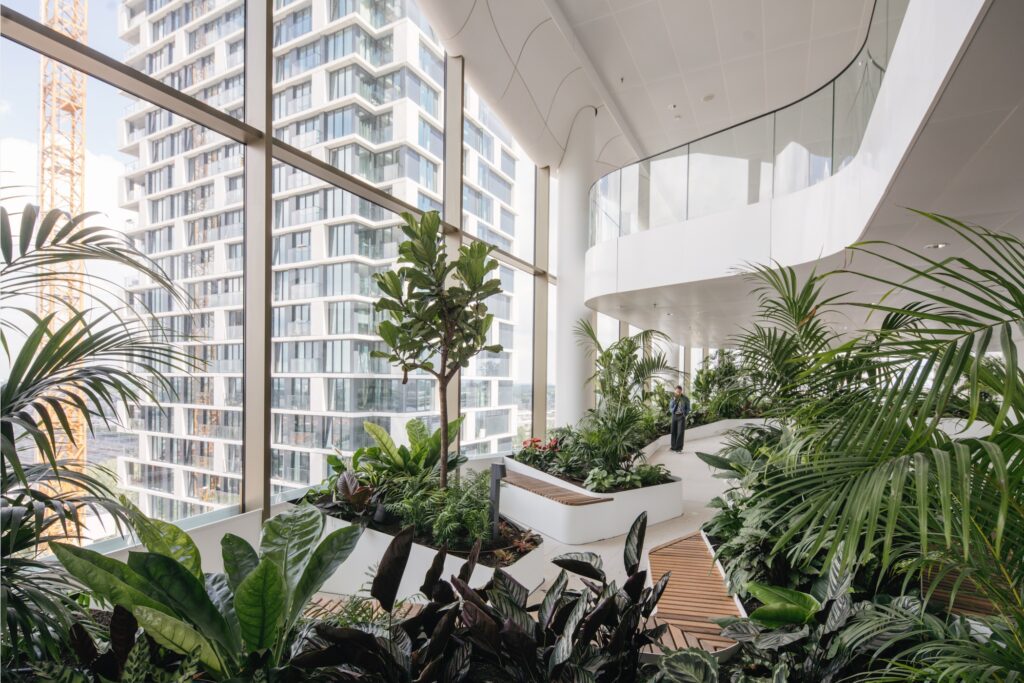
Findings on heart rate, blood pressure, and stress levels, indicate that natural settings have a positive effect on our well-being. Some chronic conditions can even be prevented with health-promoting design.
Imagine if spending time indoors didn’t mean spending time apart from nature. MOSS has just created an indoor oasis in Utrecht, called Central Park, as an affirmation of the future of healthy buildings. Read more about the project and collaboration here.
HOW MOSS BECAME AN AMBASSADOR OF HEALTH IN BUILDINGS
As the first wave of COVID-19 hit, I scrutinized my role as a designer of the built environment. Thinking about how we spend 90% of our lives indoors, and even more so during the lockdown, I contemplated how our bodies react to space. I turned lockdown boredom into busyness as I dove into the world’s first building standard focused exclusively on human health and scanned over the 236-page WELL Building Standard V1.
I familiarized myself with the latest wellness research, documentation, and requirements. Many of the metrics I was bound to learn shocked me (phthalates.. photocatalytic oxidation… equivalent melanopic lux calculations to name a few…) but I was up for the challenge.
I registered to take the exam and gave myself 6 months to pour over flashcards, mnemonics, online seminars, and tens of practice exams. The hard work paid off when I passed my first attempt with a score of 91/100 in August 2020, and became a WELL Accredited Professional (WELL AP™).
Integrating nature into the outdoor realm entails a different process in comparison to an interior space. Both Alvéole and MOSS agree that the preferred outcome for an outdoor space is for it to mimic an untamed natural landscape in avoidance of artificiality. The design of an outdoor space should be multi-layered. The space should include blossoming plants and bees in order to replicate pristine nature and enhance environments for living creatures to co-exist alongside people. A key component of enhancing biodiversity in outdoor spaces is by incorporating beehives.
THE WELL BUILDING STANDARD
The WELL Building Standard was launched in 2014 by the International WELL Building Institute (IWBI). It is a performance-based system for measuring, certifying, and monitoring features of the built environment that affect human health and well-being.
In the last six years, more than 5,000 projects have achieved the WELL Building Standard equating to more than a half-billion square feet (50 million square meters) of projects.
Scientists, health care practitioners, public health experts, and building professionals worked together to develop the standard’s 10 concepts of building performance. All in all, the concepts support and advance human health with the themes of air, water, nourishment, light, movement, thermal comfort, sound, materials, mind, and community.
- 88: Biophilia I – Qualitative
This feature intends to nurture the human-nature connection through a biophilia plan that details how nature is incorporated through the project either through environmental elements, lighting, or biomimetic patterns.
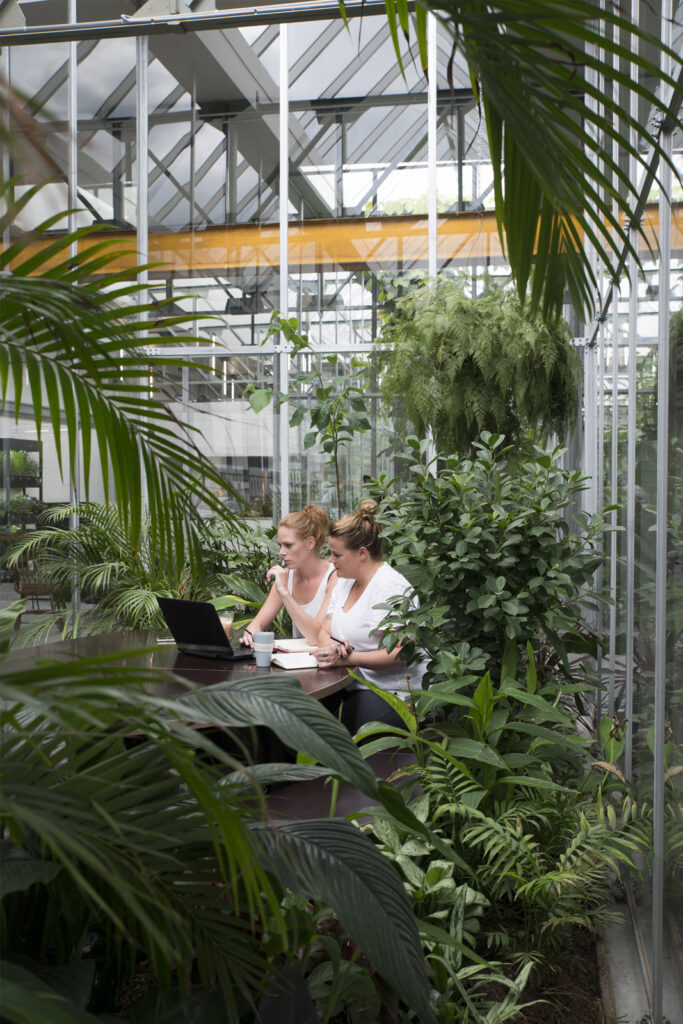
100: Biophilia II – Quantitative
For this feature, WELL project design teams must develop a biophilia plan that supports:
- Outdoor Biophilia where at least 25% of the project site must feature landscaped grounds or rooftop gardens.
- Indoor Biophilia where at least 1% of the floor area must be covered by plants, plus one living wall should be included per floor.
- Water Feature where at least one water feature should be included for every 10,000 m2.
The most recent version, WELL v2, has doubled the importance of biophilic design, now with nature taking part in four features of the v2 Mind Concept:
- M02.1 Provide Access to Nature: Projects integrate and encourage occupant access to nature within the project boundary through the following:
- Indirect connection to nature through the use of natural materials, patterns, colors, or images.
- Space layout addressing the placement of natural elements along with common circulation routes, shared seating areas, and rooms to enhance occupant exposure.
- Direct connection to nature through at least two of the below:
Plants
Water
Light
Nature views
WHERE DO WE GO FROM HERE?
While health and wellness initiatives gain momentum across the built environment landscape, our vision is stronger than ever for all people to live and work in healthy and sustainable spaces. We understand the impetus for pro-health buildings and we see them as something everyone deserves.
Are you interested in getting to know more about the power plants have on well-being or do you want to know the impact of WELL on your building? Reach out to our team at info@moss.amsterdam to take the next step.