nature is a powerful teacher
physical and mental growth are directly influenced by the environment
by Caterina Fagiolari
Sure, nature teaches us about science first hand, and we can often combine formal subjects with the outdoors, but there is so much more to take into consideration; nature teaches us patience through waiting for a bud to bloom into a flower, nature shows us compassion when we help a small creature cross a sidewalk, and nature gives us the understanding that something, or someone, doesn’t have to be perfect to be beautiful.
The theory of constructivism is a validated theory in education which posits that a child builds his understanding of the world around him based on the environment he grows up in.
It is exactly for this reason that schools and classrooms have a powerful impact on the development of a child’s character and his values’ system. These environments assume a primary role also because it has been demonstrated that children spend most of their time inside losing their contact with nature. For example, in Europe and in the US ,children spend just between two and four hours a week playing outside on an average week.
CHILDREN AND NATURE
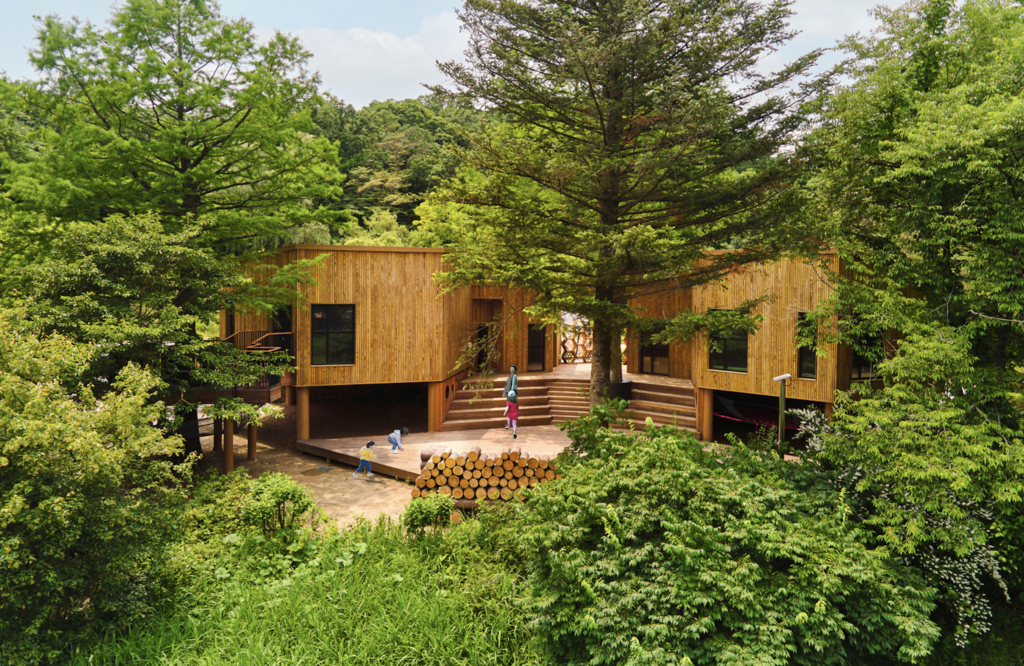
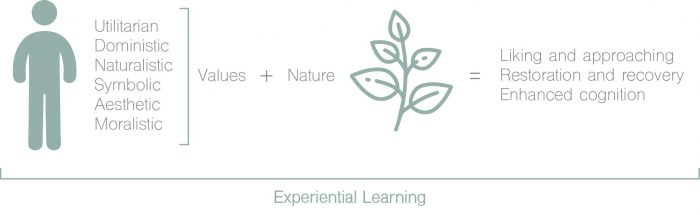
Nature has a deep imprint on a child’s life and in their memories. Children have an instinctive attraction to natural environments: they prefer to play in open spaces like gardens, fields or nearby wild places like near trees or bushes, in a courtyard or by water bodies like rivers or lakes, as they are much more invigorating than the indoors. This is a prevalent occurrence because children are experiential learners. They are born with the need to investigate, to examine, and to make sense of their experiences. There are specifically six values (diagram below) embedded within the biophilia hypothesis that are crucial to understand in relation to children development, their experiential learning path and their learning environment:
- Utilitarian values: physical benefits of nature for sustenance
- Doministic values: the challenge of mastering nature
- Naturalistic values: satisfaction from direct contact with nature providing awareness, curiosity, creativity and imagination
- Symbolic values: being able to communicate sights, sounds and senses from nature
- Aesthetic values: desire for natural beauty through symmetry, balance and harmony
- Moralistic values: ethical responsibility to nature to feel belonging to the world as a whole.
These values interact in an environment and children will have three generic responses:
- Liking or approaching
- Restoration or recovery
- Enhanced cognition
Natural settings invigorate children’s development, broaden their minds and elevate their creativity in ways incomparable to anything else. The evidence for this comes from hundreds of studies, including experimental research. For example, in one study conducted by the University of Minnesota in 2006, fifth-grade students attended school regularly at a local prairie wetlands, where subjects were taught in an integrated, experiential way as students participated in onsite research. When compared to peers attending regular schools, those who had attended school outside, interacting with nature, had significantly stronger reading and writing skills (as measured by standardized tests) and reported feeling more excited about school because of the experience. Other studies echo these findings. One of them, held in Toronto University in 2018 found that students at schools with more tree cover performed better academically—especially if they came from lower socioeconomic backgrounds.
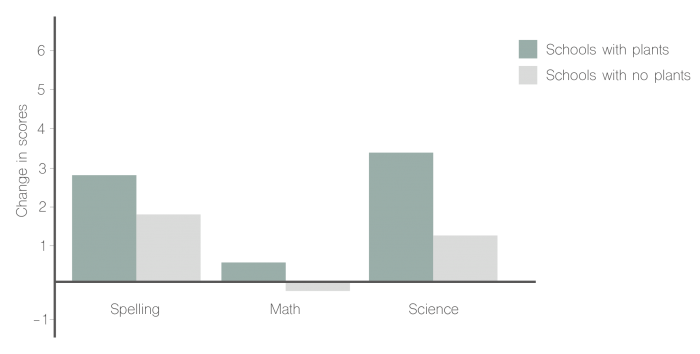
Science is only beginning to truly understand all the ways nature helps children’s learning. As vastly proven, nature improves children’s psychological and physical well being by the following means:
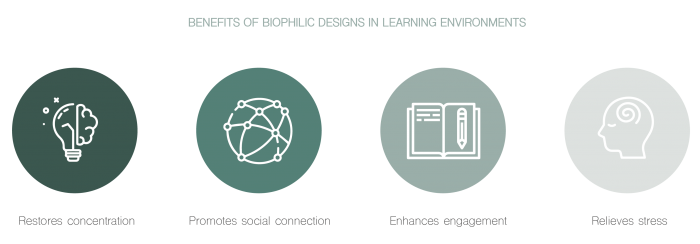
- Relieving stress: just like adults, kids and adolescents are less stressed when they are surrounded by nature. They increase their levels of daily cortisol patterns, reflecting not only less anxiety, but also better adaptation to stress.
- Developing more self-discipline: many children have problems with impulse control which can get in the way of school learning;
- Enhancing engagement in learning activities: not only children are more motivated during classes, but also they wish more to return to their classroom afterward, even if the subject they return to is not nature-related. A few experiments were conducted in South Korea, in Jeonil Middle School in Dongdaemun District, where teenagers suffer from sensory imbalance due to repeated audiovisual stimuli from digital media. Here plants are demonstrated to reduce the feeling of addiction from smartphones.
- Restoring their concentration: many kids have trouble paying attention in the classroom, whether it be because of distractions or mental fatigue. Luckily, spending time in nature and also just having a view of nature out of the window helps restore a kid’s attention.
- Promoting social connection and creativity: exploring natural elements can enhance peer-to-peer relationships and student/teacher relationships needed for learning, even for students who otherwise feel marginalized socially. Some argue that nature provides a rich tapestry of “loose parts” like sticks, stones and dead leaves that encourage pretend play and exploration, creativity and problem solving.
Even if the benefits of natural environments would have already been known , the lifestyle children of today experience, especially in our Western society, is entirely different compared to the past few generations and that of other societies. Today’s young generation has fewer opportunities that allow contact with nature as a result of various factors including rapid urbanization, the education system, that focuses on the indoors, and social pressure. Due to the lack of opportunity for adequate exposure to natural life their experiences are predominately through secondary or indirect instruments, such as visual images that are not able to give primary experiences to kids.
Even if the benefits of natural environments would have already been known , the lifestyle children of today experience, especially in our Western society, is entirely different compared to the past few generations and that of other societies. Today’s young generation has fewer opportunities that allow contact with nature as a result of various factors including rapid urbanization, the education system, that focuses on the indoors, and social pressure. Due to the lack of opportunity for adequate exposure to natural life their experiences are predominately through secondary or indirect instruments, such as visual images that are not able to give primary experiences to kids.
In trying to solve this contemporary problem, outdoor schooling has been gaining popularity as one way to provide children and teenagers with a greater access to nature, but natural engagement needs also to be functionally integrated within the school’s curriculum to be truly effective. Many schools are also placed in urban contexts where there is insufficient space to provide access to the outdoors.
Incorporating exposure to nature within the school curriculum also allows the students to learn about the natural system over time, perceiving the changes and evolutions of life in microcosm and in relation to themselves. However, biophilic design is not just about these basic health and performance requirements, it is also about the innate human need to connect with other living things. Within a school context, connection with nature provides mental relief and positive feelings of wellbeing.
CHILDREN WHO NEED SPECIAL EDUCATION SERVICES
Children with Attention-Deficit/Hyperactivity Disorder (ADHD) have unusually high and chronic levels of inattentiveness, impulsivity and hyperactivity. In a study published by the American Journal of Public Health in 2013, ADHD children were observed participating in similar activities conducted in a variety of different settings. After each session, the ADHD symptoms, such as difficulty in remaining focused and to follow directions in children exposed to the green settings, reduced significantly compared to the other settings.These behavior-modifying effects extend to kids with autism as well. “Students with autism are far more sensitive to temperature, noise, texture, and acoustics; these factors become stressors that affect the learning experience. As designers, we understand that the built environment really impacts human behavior. While biophilic design principles benefit everyone, they can really be harnessed to address issues symptomatic of students on the spectrum” shared Merilee Meacock, architect of the KSS Architects, during the presentation video of the Bancroft Mount Laurel campus
TEACHING GARDEN
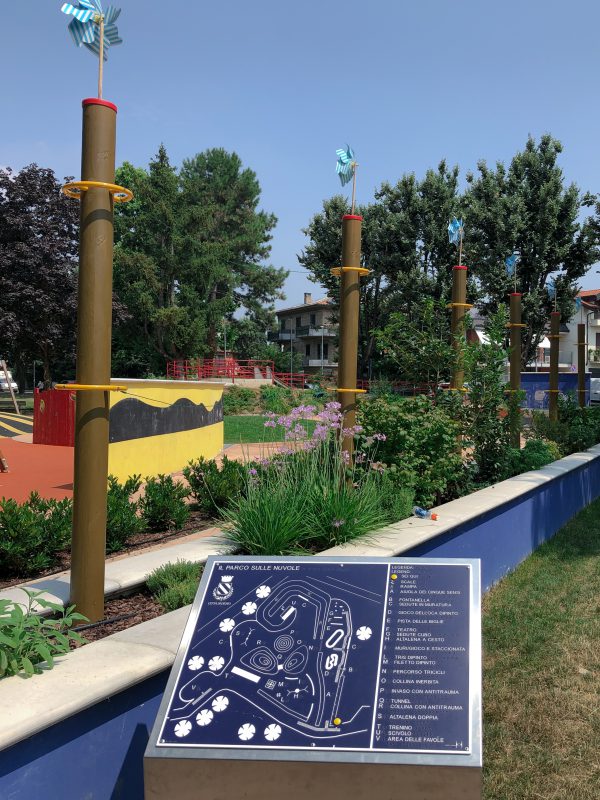
The teaching garden typology is a natural place with an environmental, recreational and educational function at the same time. A kind of outdoor classroom. This means recreating miniature ecosystems, such as a grove, a field hedge or a natural meadow where kids can learn to grow common vegetables and herbs, an ancient orchard rediscovering ancient varieties and flavors, set up tanks for recycling and composting of organic waste from the leftovers of the school cafeteria and garden waste, build and place artificial wooden nests and feeders to accommodate birds.
The different mini-ecosystems that will make up the didactic garden are all characterized, within the limits allowed, by the richness of species and especially by the autochthonous origin of the same, providing schools and cities with a green laboratory to increase or create educational and didactic opportunities related to the natural world. This can realized to help children with disabilities with flower bed dedicated to the five senses, with vegetation designed as a small botanical garden where plants can be observed through the use of the five senses, with botanical tags in braille, a tactile map or a tactile trail to help the visually impaired follow the path.
HOW CAN WE INTEGRATE NATURE IN LEARNING ENVIRONMENTS?
There is a need for a stronger connection to nature, although it remains a challenge for most schools to incorporate it in their building and curriculum and urban schools face the greatest challenge. Finding ways to incorporate nature and environmental programs in urban schools in particular is greatly important, especially given the increasingly world we live in.
We found that there are still ways around it and schools can incorporate elements of biophilic design into their plans in many other ways, such as:
- Integrating outdoor learning areas that allows more exploratory, experiential education. When a variety of native species are incorporated into the landscape, a natural habitat can be established for a more beneficial learning experience;
- Maximizing natural light and ventilation and minimizing air conditioning in favor of natural ventilation;
- Using the windows functionally to look out onto natural features as well as using clear glass over a more translucent option.
- Windows should also be adjustable with the ability to open allowing in external, natural soundscape;
- Materialization should encompass more than just using natural materials such as wood as natural details can be found in other elements like finishes that make use of symmetry and organic patterns, particularly those found in nature. This in turn encourages creativity and enhances problem-solving skills ;
- It is important to maximize the opportunity for young learners to take in and learn about plants, trees, flowers and natural species to create a direct relationship between the exterior and the interior.
- Building an internal landscape that can support biodiversity this is a good way to compensate the absence of an exterior gardens in urban schools;
- Creating a non direct connection with nature using auditory, haptic, olfactory, or gustatory stimuli that engender a deliberate and positive reference to nature, living systems, or natural processes;
- Providing, when possible, access to landscaped settings, as both retreat spaces and communal areas, which (however small) incorporate a whole ecosystem – including fauna, flora, rocks and water within them;
- Using programmed temperature changing LED and full spectrum lighting that, varying intensities of light and shadow that change over time, create conditions that occur in nature.
SUCCESSFUL EXAMPLES
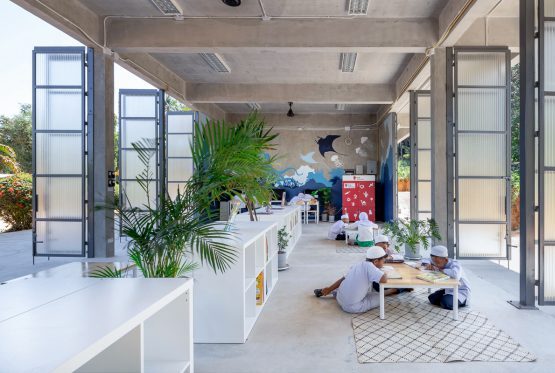
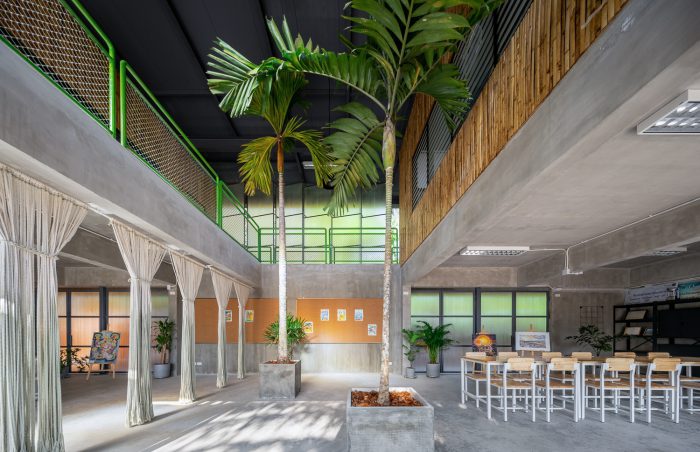
Vin Varavarn Architect designed a two floor building that has the aim to enhance the students’ learning experience in art, as the pupils studying there have demonstrated during the years an incredible artistic ability winning a high amount of national art prizes. In order to do that they created an unobstructed plan. The design accentuates the openness of the area in the direction of the natural surroundings with the use of glass walls that can be opened, creating a sensory connection with the outside by the children themselves. The walls on the second floor are cladded with bamboo wood, generating a sensation of a place that is resonating with the natural surroundings outside. Inside of the building it’s possible to find big palms that create a statement with their dimensions, dominating the built environment.
Eureka Center in Anglo Colombiano School
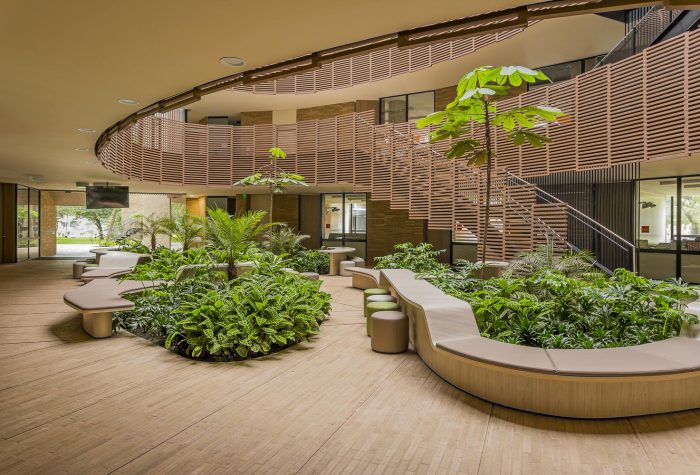
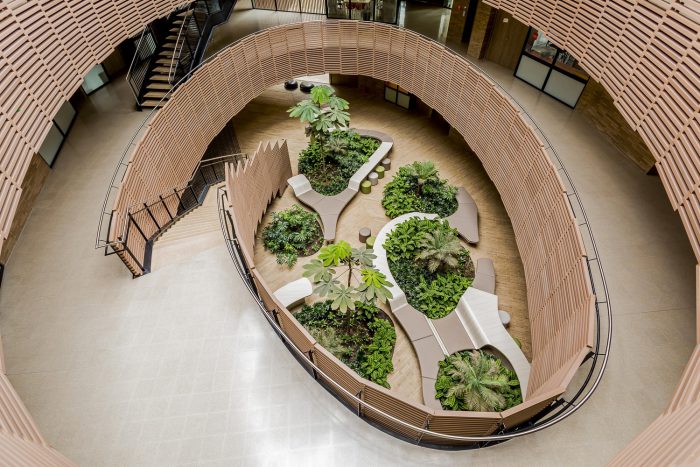
The building has, from the exterior, a static cubic shape, in contrast with the kinetic form of the inside main patio. It connects the different levels via an helical system of circulations in the middle of which grow plants that can be seen from every floor of the building. Natural materials and color palettes are used in the internal spaces, creating a connection with the forest courtyard. The oval courtyard is not just a decoration to the school classrooms, it is a place where a mix of activities can come together thanks to the presence of specific plant integrated furniture, like tables, benches and poufs.